
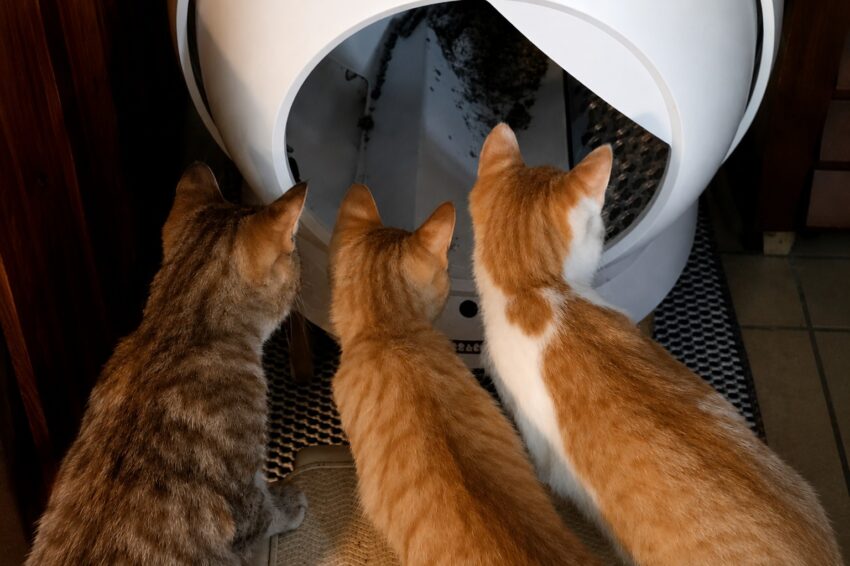
If you have multiple cats, you’ve probably heard the standard litter box rule: one box per cat, plus one extra. By that math, my six cats should have seven litter boxes. I do not have seven litter boxes.
What I do have is six cats, two automatic litter boxes, and no litter box wars. Before automatic boxes entered our lives, I had five cats sharing three traditional boxes. That worked, too.
So, can multiple cats use the same litter box? Yes, absolutely. Plenty of cats can and do share litter boxes without a problem.
That doesn’t mean the one-per-cat-plus-one recommendation is bad advice. It’s a very useful starting point, particularly if you’re introducing unfamiliar cats, dealing with territorial behavior, or trying to figure out why someone has suddenly decided that the bathmat is a perfectly acceptable toilet.
But real life is a little more complicated than a formula.
The number of boxes matters. So does their size, location, cleanliness, accessibility, and perhaps most importantly, whether your particular cats are comfortable sharing them.
And if you’re using automatic litter boxes, I think the usual math deserves even more flexibility.
How Many Litter Boxes Do Multiple Cats Really Need?
The commonly recommended formula is: Number of cats + 1 = number of litter boxes
For two cats, that’s three boxes. For three cats, four boxes. And for my household, apparently I need to find seven different places to put litter boxes.
That’s where theory starts running into the floor plan.
Our house has plenty of room for six cats. They have different places to eat, tons of room to play, and approximately nine million places to sleep. Each has favorite spots, too. Zoe has essentially claimed my bedroom as her personal territory, while the younger siblings (like Touka and Nori) are far more likely to pile on top of each other somewhere.

What I don’t have is seven sensible places to put litter boxes.
And simply lining seven boxes up in one room wouldn’t necessarily give my cats seven meaningfully different litter box resources anyway.
The better question, at least in my experience, is:
Do your cats have enough clean, accessible litter box space that everyone can comfortably use the bathroom without competing for it?
That’s a little harder to turn into a catchy rule, but it’s far more useful.
What Worked for Us With Five Cats and Regular Litter Boxes
Before we started using automatic litter boxes, my five cats shared three traditional boxes.
We kept two side-by-side in the upstairs laundry room and another downstairs in the office area. This gave them litter box access on different levels of the house without requiring us to turn every room into a feline restroom.
The big catch? We scooped every day.
There really isn’t a shortcut around that when several cats share traditional litter boxes.
The more cats using a box, the faster urine clumps and poop accumulate. And while my cats have never been particularly precious about sharing a bathroom, there’s a difference between sharing a litter box and being expected to navigate an archaeological dig to find an unused patch of litter.
Keeping those three boxes clean was what made the arrangement work.
Automatic Litter Boxes Make Sharing Much Easier
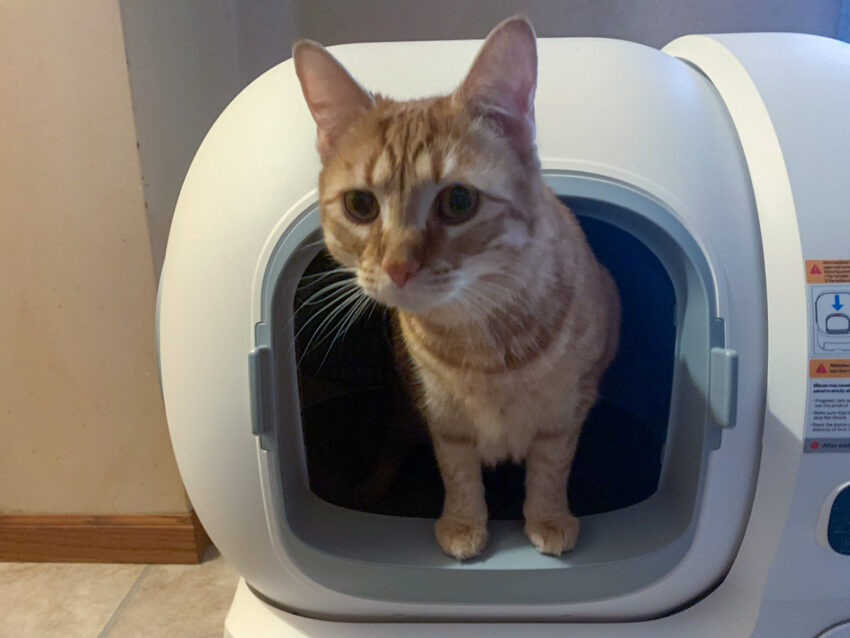
These days, we have six cats and two automatic litter boxes.
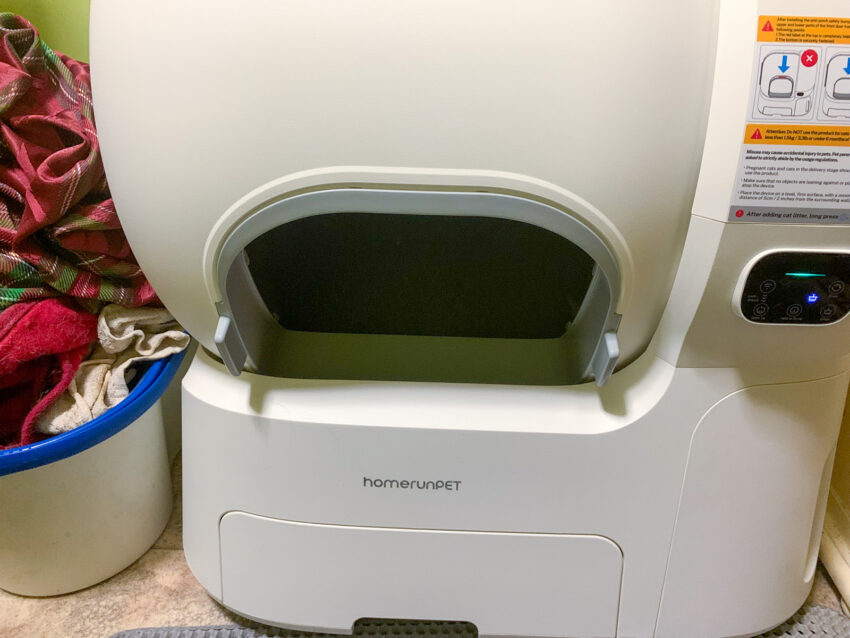
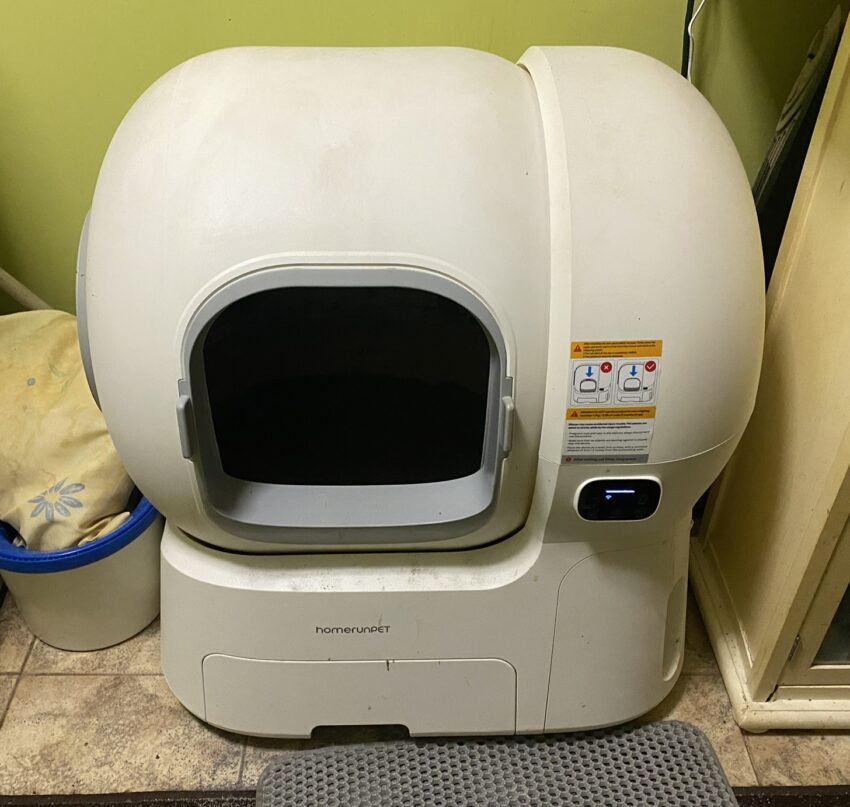
Upstairs in the laundry room, I keep the HomerunPET CS106 Self-Cleaning Litter Box, which is specifically designed with larger cats and multi-cat households in mind.
The downstairs box changes fairly regularly because reviewing automatic litter boxes is part of what I do. At any given time, we’re usually testing something designed to accommodate at least two cats.
My cats are basically unpaid litter box product testers. Their compensation package is excellent, though, so don’t feel too bad for them.
For our household, automatic litter boxes have made sharing considerably easier.
After one cat uses the box and leaves, the cleaning cycle removes the waste. When another cat wanders in later, they’re entering a relatively clean litter bed rather than stepping around whatever their sibling left behind.
Obviously, the previous cat’s scent doesn’t magically disappear. But there’s a pretty significant difference between smelling evidence that Leia was there earlier and having Leia’s pee clump sitting three inches from your foot.
I think that distinction matters in a multi-cat home.
The HomerunPET CS106 is one of the largest automatic litter boxes I’ve tested, with a roomy 106L dome and oversized 12L waste bin. Designed for big cats and real multi-cat homes, it also features an auto-refill system, ultra-quiet operation, and strong safety sensors. If you want a more hands-off litter setup, this one delivers.
BEST PRICE GUARANTEE
SAVE $60 WITH COUPON CODE PAWZ

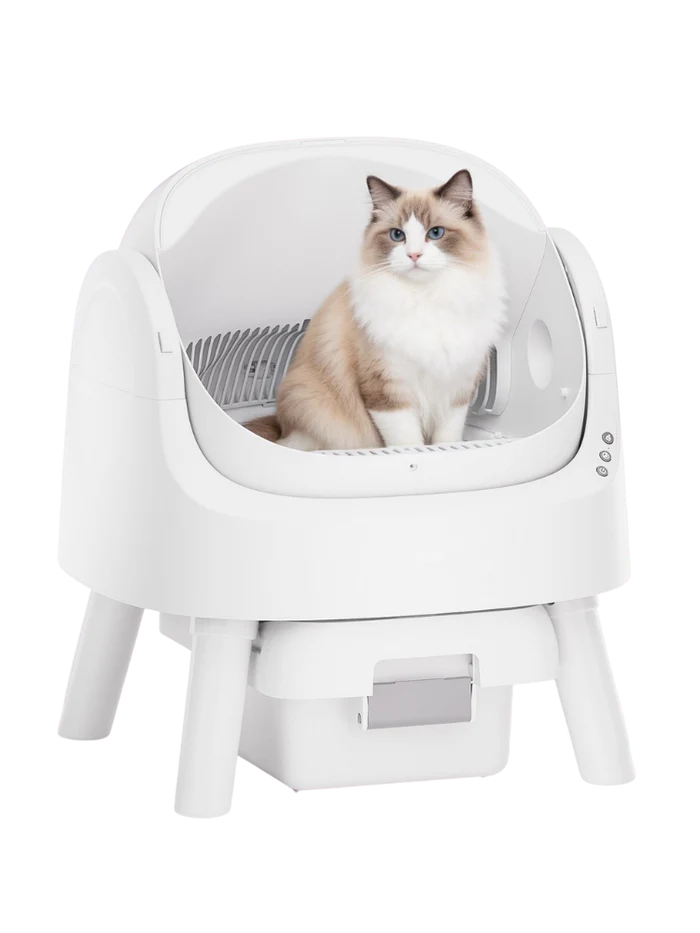
If your cats prefer an open litter box, the PetPivot AutoScooper 11 is another automatic option that makes a lot of sense for multi-cat households.
Unlike most self-cleaning boxes, it doesn’t require cats to climb into an enclosed globe. The litter area is completely open on top, so cats that are used to a traditional box may find it less intimidating (and nobody has to wonder whether another cat is lurking just outside the exit).
It also has a surprisingly large 10L waste bin. PetPivot says it can hold up to 14 days of waste for one cat, but the more useful number for this discussion is that it’s designed to hold around three days’ worth even with five cats. Obviously, how often you’ll actually empty it depends on your particular crew and their bathroom habits.
More importantly, every cat gets a freshly scooped litter bed after the previous cat leaves. That’s really the advantage of using an automatic box in a multi-cat household, whether you go with an enclosed model like the HomerunPET or an open one like PetPivot.
You still need enough litter box access for your individual cats (especially if anyone is territorial or particularly fussy about sharing), but automatic scooping removes one of the biggest reasons cats object to a communal bathroom in the first place: someone else got there first and didn’t clean up after themselves.
The PetPivot AutoScooper 11 offers affordable, hands-free litter box cleaning in a spacious open-top design. It features a 10L waste bin, quiet operation, four-layer safety protection, and three-level odor control. Its open, easy-access design also makes it a good option for larger, cautious, senior, and mobility-limited cats.
One Automatic Litter Box Isn’t Exactly the Same as One Regular Box
This is also why I don’t think you can necessarily apply the traditional litter box formula exactly the same way to automatic boxes.
Think about what happens with a regular box shared by three cats.
- Cat #1 uses it.
- Cat #2 uses it.
- Cat #3 uses it.
Unless you happen to be standing nearby with a scoop every time someone goes, all three “deposits” remain in the litter until you clean the box.
With an automatic litter box, waste is removed between visits (assuming the cats aren’t all staging a coordinated bathroom event).
That essentially resets the usable litter surface over and over throughout the day.
It doesn’t mean one automatic box is automatically enough for six cats. I wouldn’t rely on a single one for mine. But its capacity as a shared resource is very different from that of a traditional box that gets scooped once or twice a day.
Yes, My Cats Really Do Share Them
My cats have always shared litter boxes, so sharing isn’t something we had to convince them to do.
They learned from day one that the litter boxes were communal property. Nobody seems particularly concerned about who used which box before them. That history probably helps.
If you have adult cats who have always had individual litter boxes and suddenly remove half of them, you may get a very different reaction. Cats are famously non-supportive of household changes they did not personally authorize.
Our younger cats have taken sharing to another level entirely.
Kittens apparently have zero manners when it comes to bathroom privacy. I’ve seen them try to use an automatic litter box together because waiting 45 seconds for your sibling to finish is obviously an unreasonable burden.
Fortunately, good automatic boxes have safety sensors that prevent the cleaning cycle from running while a cat is still inside or immediately nearby. That’s especially important in a multi-cat home where one cat may investigate while another is finishing up.
Does Sharing the Same Litter Box Cause Territorial Problems?
Not for us, but it can. This is where I’d pay much more attention to the cats than to any specific numerical rule.
Some cats really don’t mind sharing. Mine don’t. Other cats may guard litter boxes, ambush another cat as they leave, or become reluctant to enter a box that smells strongly like another cat.
This is particularly worth watching when you’re introducing new adult cats who don’t already have an established relationship.
Signs that your cats may need additional boxes include:
- Waiting or hovering while another cat uses the box
- Guarding the entrance to a litter box
- Chasing or ambushing another cat near it
- Frequently finding one box unused while another is constantly occupied
- Urinating or defecating outside the litter box
- Hesitating before entering
- Suddenly developing unusual litter box habits
- One cat consistently traveling farther to avoid a particular box or location
If any of those things start happening, I’d add another litter box before trying to convince the cats that the current arrangement should work. They’re the ones voting here.
Location Matters Almost as Much as Number
One thing I wouldn’t recommend is taking five litter boxes and putting all five right next to each other, then assuming you’ve given your cats five completely separate bathroom options.
From the cats’ perspective, you’ve mostly created one giant bathroom area.
When we used three traditional boxes, two were upstairs in the laundry room and one was downstairs. Now we still maintain upstairs and downstairs litter box areas.
That gives a cat another option if one location is occupied or someone simply doesn’t feel like going upstairs.
It’s also useful in a larger or multi-story home. A cat shouldn’t have to cross the entire house every time nature calls, particularly as they get older.
If you have cats who don’t always get along, separating litter boxes becomes even more important. One cat shouldn’t be able to block access to every bathroom simply by planting themselves in a doorway.
Cleanliness Is Non-Negotiable When Cats Share
If you’re going to have fewer litter boxes than the traditional recommendation, you need to make up for it with maintenance.
With our traditional boxes, that meant daily scooping.
With the automatic boxes, the machines handle the scooping, but they aren’t maintenance-free. We typically empty the waste bags every two or three days, depending on which box has been declared Favorite Litter Box of the Week.
Yes, they have favorites. No, I have no idea what criteria they’re using.
We also top off litter as needed (although the HomerunPet litter box can do this for you) and regularly clean the parts of the box that inevitably collect dust, litter, and general cat-related grime.
Automatic doesn’t mean you can install the box and forget that it exists. It just means you’re removing waste bags instead of hunting through litter with a scoop every day. With six cats, I’ll happily take that trade.
But Doesn’t It Smell With Six Cats Sharing Two Boxes?
Surprisingly, no. Even before we switched to automatic boxes, having five cats use three regularly scooped litter boxes wasn’t dramatically stinkier than having five or six separate boxes would have been.
More boxes don’t make the waste disappear. Five cats are still producing the same amount of pee and poop regardless of whether it lands in three boxes or six.
The biggest factor is how long the waste sits there.
That’s another major advantage I’ve found with automatic litter boxes. Instead of waste remaining exposed until someone scoops it, it’s removed from the litter bed and deposited into an enclosed waste drawer.
You still have to empty that drawer, of course. We have not yet reached the stage of technological advancement where cat poop teleports itself out of the house.
But keeping waste contained makes a noticeable difference.
When I Would Add More Litter Boxes
Just because our two-box setup works doesn’t mean I’d insist on sticking with it if something changed.
I’d add another box if:
- One of my cats started peeing outside the boxes
- A cat began guarding access
- Someone seemed reluctant to use either box
- Two boxes couldn’t keep up with six cats
- A senior or mobility-impaired cat needed a closer option
- We introduced a new cat who wasn’t comfortable sharing
- One of the automatic boxes was going to be unavailable for an extended period
That last one is worth thinking about if you rely heavily on automatic litter boxes. Machines can malfunction. They need deep cleaning. Sometimes you’re testing a new model and discover that one of your cats apparently objects to it for reasons that make no sense to you. Having a backup plan matters.
When Multiple Cats Probably Shouldn’t Share One Litter Box
There are situations where I’d be much more cautious about expecting cats to share.
If one cat has a medical condition that requires you to monitor urine or stool output, individual boxes may make it easier to know exactly what’s happening.
I’d also provide more options for cats with a history of territorial conflict, litter box avoidance, urinary problems associated with stress, or significant mobility differences.
And sometimes two cats just have very different opinions about bathrooms.
One may prefer an enormous open box while another wants privacy. One may tolerate a particular litter while another acts as though you’ve filled the box with broken glass.
The goal isn’t to make cats share because technically they can. It’s to find the setup that keeps everyone reliably using the litter box.
Just a head’s up, if you DO need to monitor a specific cat for potential health issues, go with Pretty Litter in that litter box. It’s not a diagnostic tool but it does help you catch possible issues ahead of time.
PrettyLitter is a smart, lightweight cat litter with absorbent crystals that trap odors and eliminate moisture. It changes color to monitor your cat's health, detecting issues like UTIs. One 8lb. bag lasts up to 2 months, reducing waste and maintenance. With a low-dust, perfume-free formula, it's ideal for single and multi-cat households—just scoop the poop and enjoy peace of mind.
⭐ LIMITED TIME OFFER ⭐
GET 20% OFF + FREE LITTER MAT

Regular vs. Automatic Litter Boxes for Multiple Cats
| Regular Litter Box | Automatic Litter Box | |
|---|---|---|
| Can multiple cats share it? | Yes | Yes |
| Waste removed after each use? | Only if you scoop it | Usually |
| Daily scooping needed? | Yes, especially with multiple cats | No |
| Waste bag/drawer needs emptying? | N/A | Yes |
| Good for heavy multi-cat use? | Yes, with frequent cleaning | Often especially well suited |
| Initial cost | Low | Much higher |
| Ongoing maintenance | Frequent scooping and cleaning | Emptying drawer, topping off litter, cleaning |
| Helps reduce exposed waste? | Only when frequently scooped | Yes |
| Requires electricity? | No | Yes |
I wouldn’t tell anyone they need an automatic litter box simply because they have multiple cats. Traditional boxes worked perfectly well for us for years.
But after living with both setups, I definitely prefer automatic boxes for a multi-cat household. Not having six cats’ waste accumulate between scooping sessions is a pretty compelling feature all by itself.
So, How Many Litter Boxes Should You Have?
Start with the standard recommendation if you have the room and budget. There’s certainly nothing wrong with giving cats more bathroom options.
But I wouldn’t panic if you can’t fit one litter box per cat plus an extra into your home.
Instead, look at the entire setup.
Do your cats comfortably share? Are the boxes large enough? Are they kept clean? Are there boxes in more than one area of the house? Can every cat access them without being blocked or intimidated? Is anyone eliminating elsewhere?
If everything is working, you don’t necessarily need to add boxes simply because a formula says you’re short.
I’ve had five cats successfully share three traditional litter boxes, and today six cats share two automatic ones. That’s not proof that every six-cat household only needs two boxes. It’s proof that there isn’t one perfect number for every multi-cat household.
The “cats plus one” rule is a good starting point. Your cats, your floorplan, and your budget get the final say.


