If your cat’s sleeping habits have changed lately, this guide may help you catch something early — or finally explain why Leia is on your face at 3am.
I’ve been owned by cats for my entire adult life — and if there’s one thing I’ve learned after years of sharing my home with Zoe, Alex, and Leia (plus a revolving cast of ferals out back), it’s that how a cat sleeps tells you more about them than pretty much anything else.
Honestly, cats are dramatic little mysteries wrapped in fur. One minute Leia is draped across my face like a furry sleep mask, the next she’s wedged into a shoebox with her legs at absolutely impossible angles. And every single time, there’s a reason for it.
Most articles on this topic scratch the surface and move on. We wanted to do something different. This guide covers every cat sleeping position you’re likely to encounter (and a few you probably never expected), what the latest science actually says about feline sleep behavior, and what you should do when something seems off.
Why Do Cats Sleep So Much?
Before we dive into positions, a little context helps. Because understanding why cats sleep the way they do makes all those weird poses make a whole lot more sense.
Cats are polyphasic sleepers — meaning they don’t do one long sleep block like we do. Instead, they cycle through many short naps throughout the day and night, typically 15 to 30 minutes at a stretch. Add it all up and you get somewhere between 12 and 16 hours of sleep per day for the average adult cat. Kittens and seniors? Even more — often up to 20 hours.
That’s not laziness. That’s biology. Cats are simultaneously predators and prey animals, which means evolution gave them a sleep system that keeps them relatively alert even during rest — ready to either chase something down or escape something chasing them.
What the Latest Science Says About Cat Sleep
A separate 2025 study from Research Publish Journals surveyed 200 cat owners about their cats’ sleeping positions and emotional states. The results confirmed what experienced cat owners already sense: belly-up and side-lying positions were most strongly associated with happiness and trust — 88.6% of belly-up cats were perceived as relaxed or happy, while side-sleepers were described as calm (53.6%) or relaxed and happy (39.1%). Loaf and curled positions tended to reflect alertness or mild caution. That said, individual temperament, environment, and owner interaction all play a role. No single position is a definitive emotional readout.
Solo Cat Sleeping Positions — And What Each One Means
Here’s what you came for. I’ve organized these into three categories: solo positions (your cat by themselves), location-based positions (where they sleep and why it matters), and positions with you (because cats have opinions about their humans, too).
1. The Loaf Position
You know this one. Paws tucked neatly under the body, tail curled around the sides, sitting perfectly upright. It looks zen, but the loaf is actually semi-alert rest — not deep sleep.
What it means:
Your cat is comfortable enough to relax, but not fully letting their guard down. The loaf is the classic “power nap” position — they can spring into action immediately if needed. Tail tucked tight? Slightly cool or a touch anxious. Tail loosely wrapped? Relaxed and content. Think of it as standby mode.
2. The Cinnamon Roll (All Curled Up)
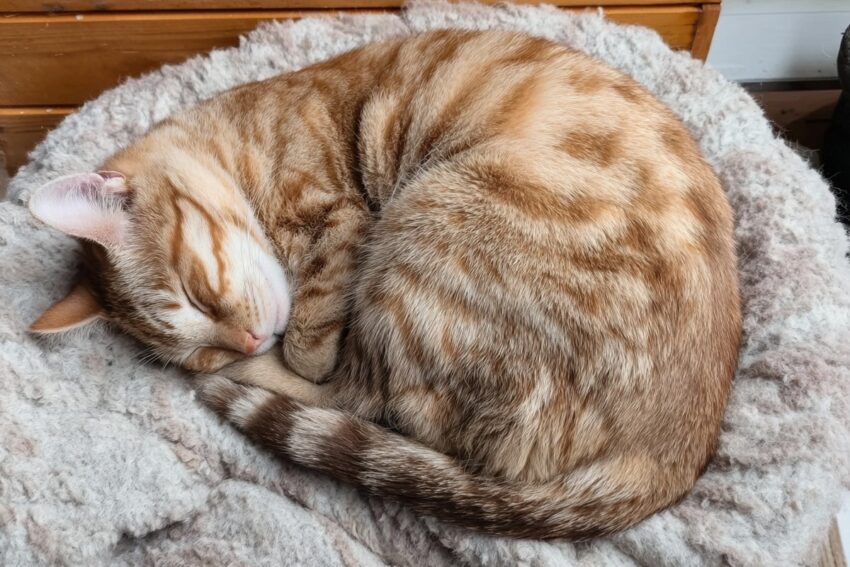
The tight ball — nose tucked toward tail, body curved into a compact circle. This is one of the most common cat sleeping positions overall. A 2025 owner survey found 26.8% of cats were most often observed in this position.
What it means:
Pure efficiency. By curling tight, cats conserve body heat and protect their most vulnerable areas — the soft belly and vital organs. It’s a deeply instinctual position carried over from wild ancestors. A tightly curled cat is comfortable and secure, but may not be in a state of total trust. That honor belongs to the next couple of positions.
3. The Sideways Sleeper (aka The Flopped-Out Cat)
Legs extended to one side, belly partially exposed, body fully relaxed. This is deep sleep territory.
What it means:
Your cat feels completely safe. No defensive posture here — they have fully committed to rest. The 2025 survey found 53.6% of side-lying cats were described as relaxed and happy. And remember that Current Biology study? If your cat tends to flop on their left side specifically — that’s the species-wide preference, and it’s not a coincidence.
FYI, this is also the position where you’re most likely to catch visible REM sleep: twitching paws, rapid eye movement, little chirps and squeaks.
4. The Belly-Up (Back Sleeping, Belly Exposed)
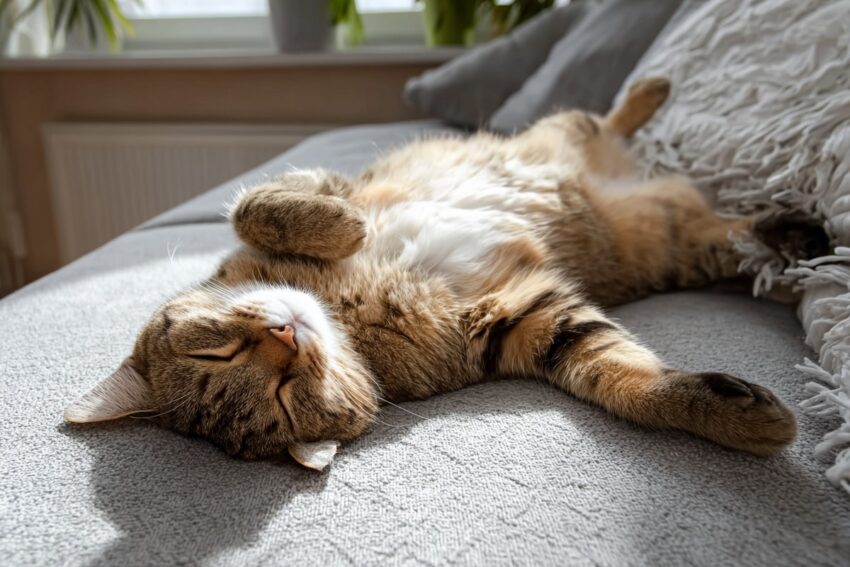
The ultimate display of trust. Flat on their back, soft belly fully exposed to the world — and to you. This is the most vulnerable sleeping position in a cat’s repertoire.
What it means:
Maximum contentment and absolute trust. The research backs this up: 88.6% of belly-up cats were perceived as relaxed or happy in the 2025 study. When your cat sleeps like this, take it as a genuine compliment — they feel completely safe.
5. Paws Over the Face
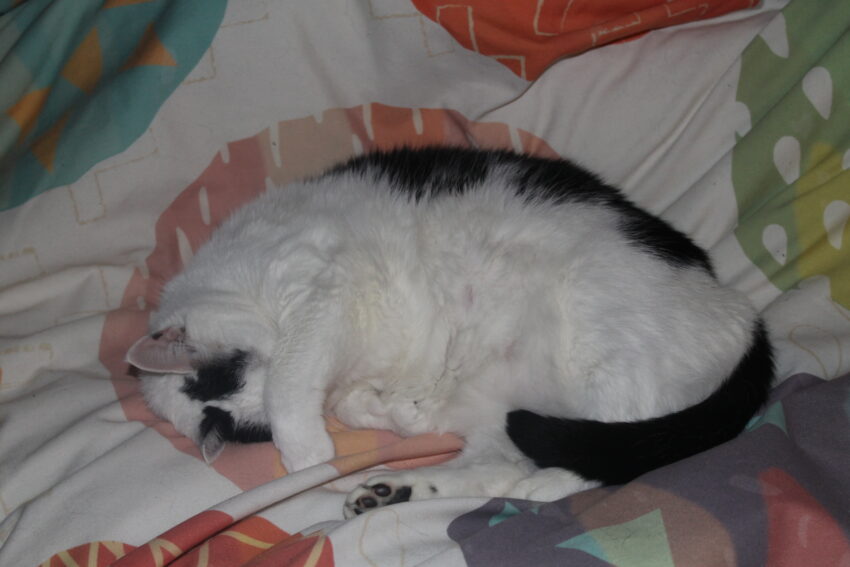
One of the most universally photographed positions — paws draped over the eyes like a tiny sleep mask.
What it means:
It blocks light and provides insulation for both the face and the paws, trapping warmth around the nose and muzzle. Think of it as your cat’s built-in blackout curtain. When a cat goes paws-over-face, they are genuinely in deep sleep. Resist the camera flash and leave them be.
6. The Superman / Sploot (Belly Down, Legs Stretched Out)
All four legs extended, belly flat on the floor, front legs forward and hind legs back — like a cat mid-flight. Also called the Sploot.
What it means:
This is a cooling position. The belly is in direct contact with a cool surface (tile floors are a favorite), which helps regulate body temperature. You’ll see this most often in summer or in warmer homes. The full stretch also signals your cat is comfortable enough to fully extend — no defensive posture here.
7. The Monorail Cat (Perching on Narrow Edges)
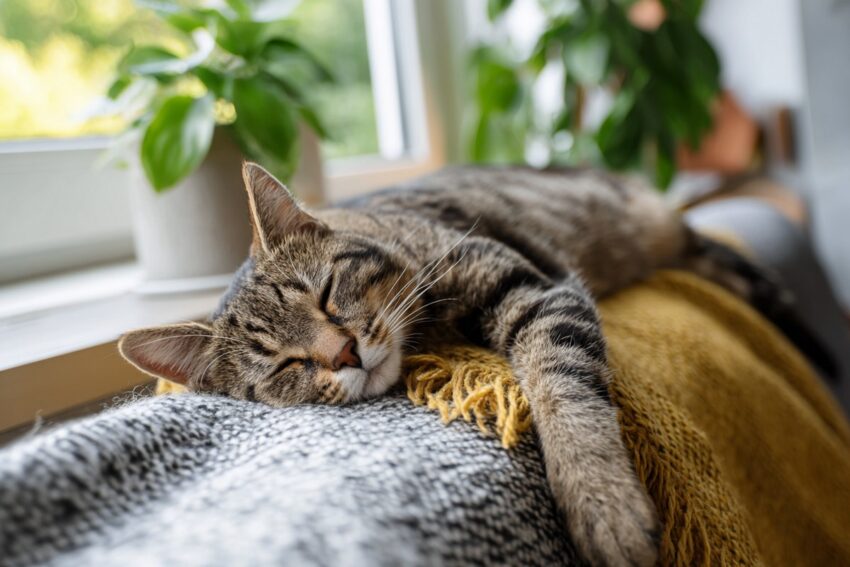
Draped over the arm of a sofa, the back of a chair, the edge of a shelf — limbs dangling on either side, body parallel to the surface.
What it means:
Ancient instinct. In the wild, big cats lounged on tree branches in exactly this position — elevated, surveying their territory, conserving energy while staying alert. Your cat sleeping on the sofa back is doing the exact same thing. Height advantage for visual monitoring, while being genuinely comfortable.
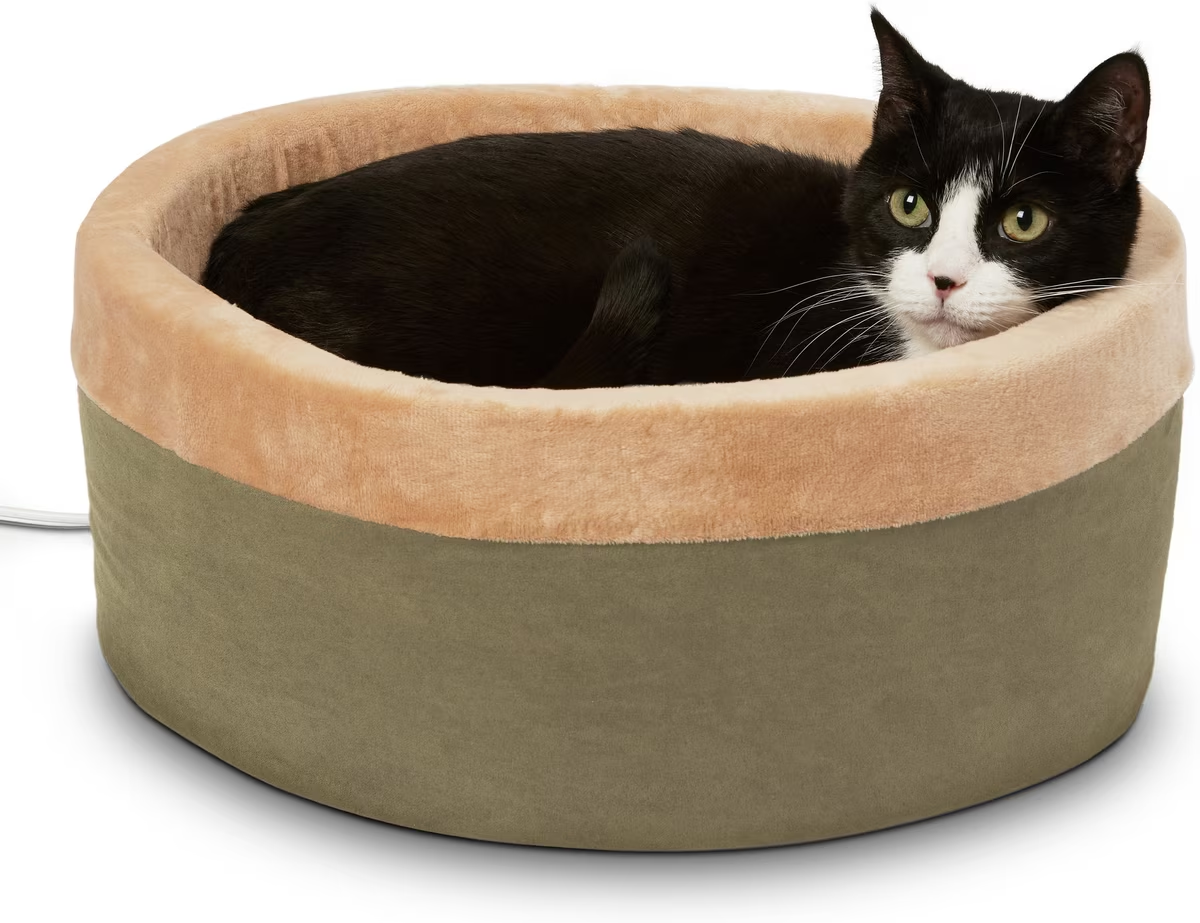
If you’re looking for a great bed to support this position, I love the K&H Thermo-Kitty bed!
The K&H Thermo-Kitty Bed has a dual thermostat 4 watt heating unit buried deep within its thick, super soft, orthopedic foam base. It warms the surface 10‐15 degrees above ambient air temperature to your cat's normal body temperature when in use. The washable cover is attractive in any room in the house. Indoor use only.
8. The Tummy Tuck (Super-Compact Loaf)
Similar to the loaf, but tucked even tighter — all four paws gathered underneath, head down close to the surface, body compacted into its smallest form.
What it means:
Warmth conservation and mild alertness. Very common in cold weather. Also seen in cats who are slightly under the weather — the tucked posture helps conserve heat and energy when they’re not feeling their best.
9. Head Up or Head Down
Head up:
Often seen in the loaf position — your cat is in light, alert sleep. They can respond quickly to stimuli. This is how cats in unfamiliar environments or multi-pet households tend to rest.
Head down:
Deeper sleep state. A cat sleeping with their head resting down on their paws or the surface trusts their environment completely. This is a cat who has let their guard down fully.
10. Buried Under Blankets / Burrowing
The cat who disappears into the duvet. Completely hidden, often creating a telltale lump under the covers.
What it means:
Warmth-seeking, security-seeking, or both. Burrowing mimics the enclosed dens their ancestors used for safety. If your cat does this regularly, they might genuinely appreciate a cave-style cat bed where they can snuggle in rather than commandeering your duvet every night. Leia has claimed the bottom corner of my duvet as her personal cave and I have simply accepted this.
Your cat or kitten will love sleeping in this self-warming, nesting cat bed. The warm, fluffy lining provides calming stress relief for cats of all ages. It has a modern and unique design that’s perfect for a sleek indoor look.

Where Your Cat Sleeps — And What the Location Tells You
It’s not just how a cat sleeps that carries meaning — it’s where. Here are the most common location-specific sleeping behaviors and what they usually signal.
11. In a Box or Small Container
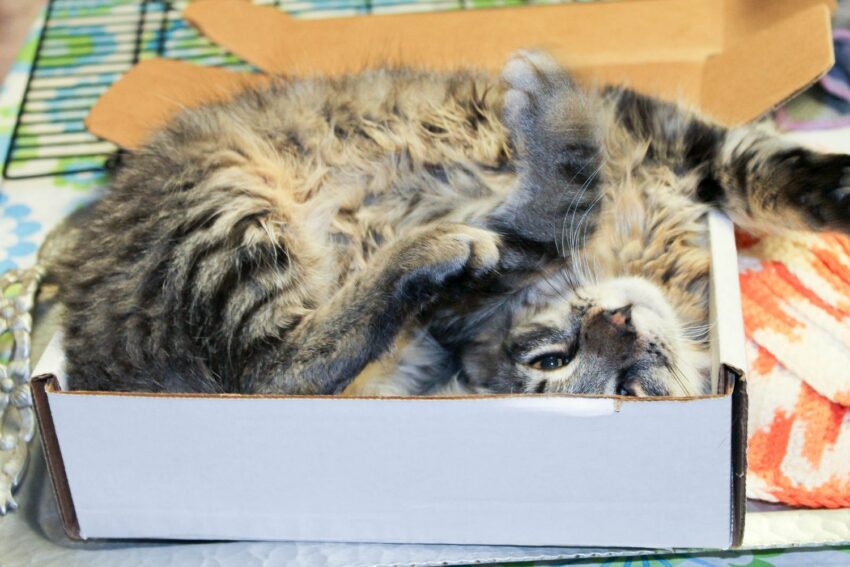
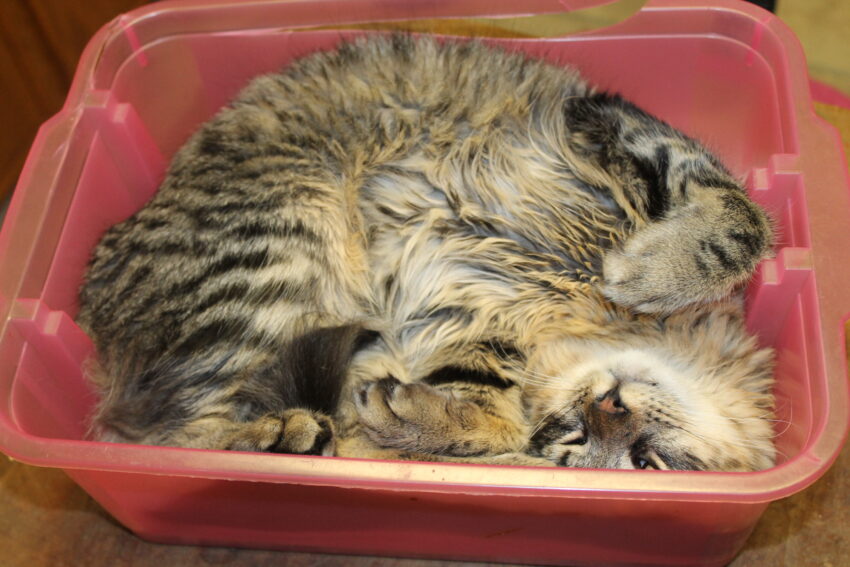
Cats and boxes. It’s basically a law of physics. If a box exists within a cat’s territory, it will eventually be slept in.
What it means:
Enclosed spaces provide a clear field of view while limiting access to blind spots. A box offers defined walls, predictable entry points, and a sense of security that open spaces simply don’t. Research from the University of Utrecht showed that shelter cats given boxes adapted to their environment faster and showed lower stress scores than those without. Your cat’s box obsession is entirely rational.
12. In the Bathroom
Cool tile, privacy, proximity to running water, familiar scents. The bathroom is apparently cat paradise for napping.
What it means:
Usually one of three things: they want the cool surface for temperature regulation, they want solitude and privacy, or they’ve learned you reliably appear there at predictable times and want to intercept you. (Leia has mastered this. I cannot shower in peace.) Occasionally, cats also seek out cool surfaces when running warmer than normal. If bathroom napping is new behavior alongside other symptoms, worth mentioning to your vet.
13. Changing Sleeping Spots Frequently
You put down a brand-new cat bed. Your cat sleeps in the cardboard box it came in. Classic. But beyond the box thing, cats also rotate sleeping spots regularly by nature.
What it means:
In the wild, rotating sleeping spots was a safety strategy — don’t give predators a predictable location. Domestic cats retain this instinct. Rotating spots is completely normal. However, a cat who suddenly abandons a long-used spot, or who is restless and unable to settle anywhere, may be experiencing discomfort or pain. That’s worth paying attention to.
14. In the Litter Box
Let’s be honest — this one is not cute. This is a red flag.
What it means:
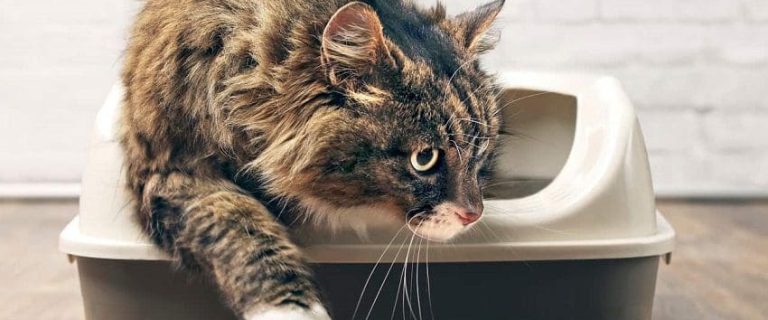
A cat sleeping in the litter box usually indicates one of the following: extreme stress or fear (the litter box feels like the only safe enclosed space), a urinary or digestive issue causing them to stay close to the box, or — in multi-cat households — bullying that’s forcing them to claim and defend their spot. If your cat is sleeping in the litter box, please don’t ignore it. Rule out a UTI, blockage, or GI issue with your vet first. If it’s behavioral, address the root cause.
Using a cat health monitoring litter like PrettyLitter can help you detect issues early.
PrettyLitter is a smart, lightweight cat litter with absorbent crystals that trap odors and eliminate moisture. It changes color to monitor your cat's health, detecting issues like UTIs. One 8lb. bag lasts up to 2 months, reducing waste and maintenance. With a low-dust, perfume-free formula, it's ideal for single and multi-cat households—just scoop the poop and enjoy peace of mind.
⭐ LIMITED TIME OFFER ⭐
GET 20% OFF + FREE LITTER MAT

Cat Sleeping Positions With Their Owners
Here’s where it gets personal. Where and how your cat chooses to sleep relative to you is one of the most reliable indicators of trust and bonding. Research by Chomel & Sun (2011) found that 62% of cats sleep with their adult owners — indicating a strong species-wide preference for sleeping near trusted humans.
15. At the Foot of the Bed
What it means:
Your cat wants to be near you but also values their independence and escape options. The foot of the bed is strategic — close enough for warmth and connection, far enough to maintain their own space and a clear exit if needed. This is very common in cats who love you but also have their dignity to maintain. It can also be a temperature thing — feet generate less body heat than the torso, so the foot of the bed runs a bit cooler.
16. Between Your Legs
What it means:
Security and warmth. The space between your legs creates a small, enclosed, body-heat-generating zone that cats find irresistible. Cats who sleep between their owner’s legs tend to have a strong bond — this is a trust position.
The downside, of course, is that you now cannot move. Leia has pinned me in place for what felt like geological epochs. You learn to work around it.
17. Pressed Against You (Side-by-Side or Spooning)
What it means:
Littermates sleep pressed together for warmth and reassurance. When your cat presses against your body during sleep, they are treating you as a littermate — which is genuinely one of the highest compliments a cat can give. It’s about warmth, scent, and a fundamental sense of safety.
18. On Your Chest
What it means:
Your chest offers three things cats love: warmth, the sound of your heartbeat, and proximity to your face and breath (which carries your unique scent). Cats that sleep on your chest have a deep bond with you. The heartbeat connection is thought to be especially soothing — it echoes the sound they heard while nursing as kittens.
19. On Your Face
Yes. They do this. It’s alarming and not always great for breathing, but there is a reason.
What it means:
Your face carries the strongest concentration of your scent. Your breath, your hair, the warmth around your head — it’s deeply appealing to a bonded cat. It can also be warmth-seeking behavior (your face is one of the warmest parts of your body during sleep). That said — while it means they love you, it’s perfectly okay to gently relocate them. You have to breathe.
20. On Your Pillow
What it means:
Your pillow is saturated with your scent from hours of contact every night. Cats find that deeply comforting. It can also be an attention-getting behavior for cats who want more interaction from you. Alex does this. Every single morning.
21. At Your Feet (While You’re Awake)
What it means:
Companionship with independence. A cat who settles at your feet while you’re at your desk or on the couch is saying “I want to be near you” without requiring physical contact or interaction. This is common in more reserved cats who are deeply attached but not overly demonstrative.
22. Why Won’t My Cat Sleep With Me?
Some cats simply don’t want to share your bed, and that’s completely fine. Cats are individuals. Common reasons include:
• Temperature preferences:’, ‘ Your body heat might be more than they want, especially for cats who run warm.
• Light or sound sensitivity:’, ‘ Electronics, streetlights through blinds, or a restless sleeper can all be deterrents.
• Movement during sleep:’, ‘ If you toss and turn, they’ll opt out for self-preservation.
• Independence:’, ‘ Some cats are simply solitary sleepers by temperament. This is not a rejection — it’s just who they are.
23. Why Won’t My Cat Sleep in Their Bed?
Extremely common — and usually fixable. Most cats avoid a new bed because it doesn’t smell right yet (try placing a worn t-shirt inside it), the location is wrong (high-traffic areas are a no), or the style doesn’t suit them (a flat mat for a cat who wants to burrow is not going to work). Trial and error is very much your friend here.
Cat Sleep Behaviors: Twitching, Purring, Growling, and More
Beyond positions, cats also exhibit some fascinating (and sometimes alarming-looking) behaviors during sleep. Here’s what’s actually going on.
Cat Twitching in Sleep
Completely normal — and genuinely fascinating. Twitching during sleep (paws paddling, tail flicking, whiskers moving, teeth chattering) is a sign your cat is in REM sleep and very likely dreaming. Researchers have observed that cats appear to act out their dreams during this phase — probably hunting, playing, or whatever dominated their day.
Key rule:
Don’t wake a twitching cat. All sleep stages matter for their health. Unless the movement is violent or seizure-like — full-body rigid shaking, loss of bladder control, extended unconsciousness — leave them be.
Cat Purring While Sleeping
Yes, cats purr in their sleep. It’s not super common but it does happen, especially during lighter sleep phases. Purring is generally associated with contentment, but cats also purr as a self-soothing mechanism when stressed or unwell.
What it means:
In a sleeping cat, purring almost always signals contentment and comfort. If your cat purrs themselves to sleep, that’s one of the clearest signs they feel genuinely safe in their environment.
Cat Growling or Chattering in Sleep
That weird chattering noise — the “ack-ack-ack” directed at birds through a window — can happen during sleep too. As can a low growl or vocalization.
What it means:
Almost certainly dreaming. The chattering is a hunting vocalization, and cats in REM sleep can vocalize as they process the day’s events. A sleeping growl is usually equally innocent — they’re working something out in dreamland. If growling continues after waking, or your cat seems disoriented upon waking, that’s worth noting.
Cat Sleeping Positions When Sick — Warning Signs to Watch
Most of the time, a weird sleeping position is just a cat being a cat. But there are some position changes and behavioral shifts that deserve attention. This is the section to bookmark.
Watch for these changes:
- Suddenly sleeping far more than usual — especially over 20 hours/day with no environmental explanation
- Hunched posture with head tilted down and body tense — a key sign of pain, often associated with kidney disease, pancreatitis, or GI issues
- Sleeping in the litter box (see above — this is never normal)
- Reluctance to change positions, or obvious discomfort when moving or stretching
- New sleeping spots that are unusual — hiding under beds, in closets, in low dark spots — combined with other symptoms. Cats instinctively hide when they’re seriously unwell
- Changes in sleeping position alongside loss of appetite, vomiting, changes in water intake, or unexplained weight loss
The challenge is that cats are notoriously good at masking pain and illness. By the time they’re showing visible signs, things have often been building for a while. This is where technology can genuinely help. I highly recommend the PetPace Smart Cat Collar.
The PetPace Cat Collar goes beyond simple tracking by monitoring vital signs like temperature, pulse, respiration, stress levels, sleep, and activity. With AI-powered health insights and built-in GPS, it gives cat owners a deeper look at their pet’s overall wellness.
⭐ GUARANTEED BEST PRICE ⭐
USE COUPON CODE TECHNO10 AT CHECKOUT TO SAVE 10%

Quick Reference: Cat Sleeping Positions at a Glance
For your skimmer friends (I see you — I’m one of them 😀), here’s the cheat sheet:
| Position | Trust Level | Sleep Type | Quick Meaning |
|---|---|---|---|
| Cat Loaf | Moderate | Light / Alert | Power nap mode — comfortable but ready to spring |
| Cinnamon Roll (Curled) | Moderate | Light to moderate | Heat retention, organ protection — instinctual and secure |
| Sideways Sleeper | High | Deep | Fully relaxed — 2/3 of cats prefer left side (science-backed) |
| Belly-Up | Very High | Deep | Maximum trust and contentment — don’t assume it’s a belly rub invite |
| Paws Over Face | High | Deep | Do Not Disturb — blocking light, conserving warmth |
| Superman / Sploot | High | Moderate to deep | Cooling down — belly on cool surface, fully at ease |
| Monorail Cat | Moderate | Light to moderate | Ancestral surveillance — elevated view, still alert |
| Tummy Tuck | Moderate | Light | Warmth and mild caution — watch if combined with other symptoms |
| Burrowing / Under Blankets | High | Deep | Warmth-seeking, den instinct — completely safe and cozy |
| In a Box | Moderate | Any | Enclosed = secure — totally rational cat logic |
| In the Litter Box | — | CONCERN | Not normal — stress, pain, or health issue. Call your vet. |
| At Foot of Bed | High | Any | Bonded but independent — wants closeness with exit options |
| Between Your Legs | Very High | Deep | Security and warmth — strong trust bond |
| On Your Chest | Very High | Deep | Heartbeat comfort — deep bond, echoes kitten nursing |
| On Your Face / Pillow | Very High | Deep | Your scent is the draw — highest compliment possible |
| Hunched / Tense Posture | — | CONCERN | Possible pain or illness — especially with other symptoms |
Frequently Asked Questions
What does it mean when a cat sleeps on you?
It means you’ve earned their trust — fully. Cats only sleep on or very close to humans they feel completely safe around. It’s one of the clearest behavioral signals of a strong bond. Whether they choose your chest, your legs, or your face, they’re treating you as a safe, warm companion they can fully relax with.
Why does my cat sleep on my chest specifically?
Three reasons that work together: the warmth of your body, the rhythmic sound of your heartbeat (which echoes what kittens hear while nursing), and the concentration of your personal scent. Cats are highly sensitive to familiar sounds and smells. Your chest offers all three at once.
What cat sleeping positions indicate illness?
The positions most associated with illness are: hunched or tucked posture with visible tension, particularly if it’s new behavior; sleeping in the litter box (always a red flag); hiding in unusual dark or low spots; and sudden changes in routine sleep spots. None of these alone are definitive — but combined with other symptoms (appetite changes, lethargy, vomiting, changes in water intake), they warrant a vet call. The “cat sleeping positions when sick” pattern is real and worth knowing.
Why do cats sleep on their left side?
A 2025 study in Current Biology found that approximately two-thirds of cats prefer to sleep on their left side. Researchers believe this is an evolutionary advantage: sleeping left-side-down means the right hemisphere of the brain — which specializes in threat detection and rapid escape responses — has an unobstructed view upon waking. Even in the safety of your home, your cat’s ancient survival software is still running.
Why do cats sleep so much?
Cats are obligate carnivores whose wild ancestors needed to conserve energy between hunts. Their polyphasic sleep pattern — many short naps rather than one long sleep — evolved to keep them ready for bursts of high-intensity activity. Adult cats sleep 12–16 hours daily; kittens and seniors often sleep up to 20 hours. This is entirely normal physiology, not laziness.
Is it normal for cats to twitch while sleeping?
Yes, completely normal. Twitching, paddling paws, tail flicking, and vocalizing during sleep are signs your cat is in REM sleep and likely dreaming. Do not wake them. The only time twitching should concern you is if it’s full-body rigid shaking that doesn’t stop within a minute or two, combined with disorientation upon waking — that could indicate a seizure disorder and warrants an immediate vet call.
Why won’t my cat sleep in the cat bed I bought?
Usually one of three reasons: it doesn’t smell like them yet (try placing a worn t-shirt in it for a few days), the location is wrong (cats don’t want to sleep in high-traffic areas), or the style doesn’t match their preference (an open flat bed for a cat who wants to burrow won’t work). Match the bed style to their sleeping preference — curlers and burrowers want cave-style beds; sprawlers and belly-up cats prefer open flat beds.
Should I let my cat sleep with me?
That’s a personal decision, and there are reasonable arguments on both sides. Benefits include reduced stress for both you and your cat, stronger bonding, and the deeply soothing effect of a purring cat nearby. Drawbacks include sleep disruption (especially if your cat is active at night), allergen exposure, and hygiene considerations. There’s no single right answer — if it works for your household and your cat’s health is good, it’s genuinely fine.
What does it mean when a cat sleeps pressed against you?
Littermates sleep pressed together for warmth and reassurance. When your cat does this with you, they’re treating you as a littermate — signaling complete trust and a desire for closeness. It’s a bonding behavior, not just warmth-seeking. Cats who sleep pressed against their owners consistently tend to have very strong bonds with their humans.
Can a cat’s sleeping position change as they age?
Yes, and this is worth knowing. Senior cats (10+) often shift from sprawled-out positions to more compact, tucked poses — partly because joints become less comfortable, and partly because they lose body heat more easily. If your senior cat has recently shifted to a much more hunched or tucked sleeping position, especially alongside other behavioral changes, mention it to your vet. It can be a sign of arthritis or another age-related condition.
Final Thoughts
Here’s what I want you to take away from all of this: your cat’s sleeping positions are not random. They are a direct reflection of how safe, comfortable, and bonded your cat feels — shaped by millions of years of evolutionary programming that doesn’t disappear just because they have a heated cat bed and a Litter-Robot.
Pay attention to the patterns, not just the individual moments. The positions your cat uses consistently are much more meaningful than any single snapshot. And when something changes — especially if it changes alongside other symptoms — trust your gut and call your vet.
Your cat can’t tell you with words that something’s wrong. But their body language? That, they’re very good at.