
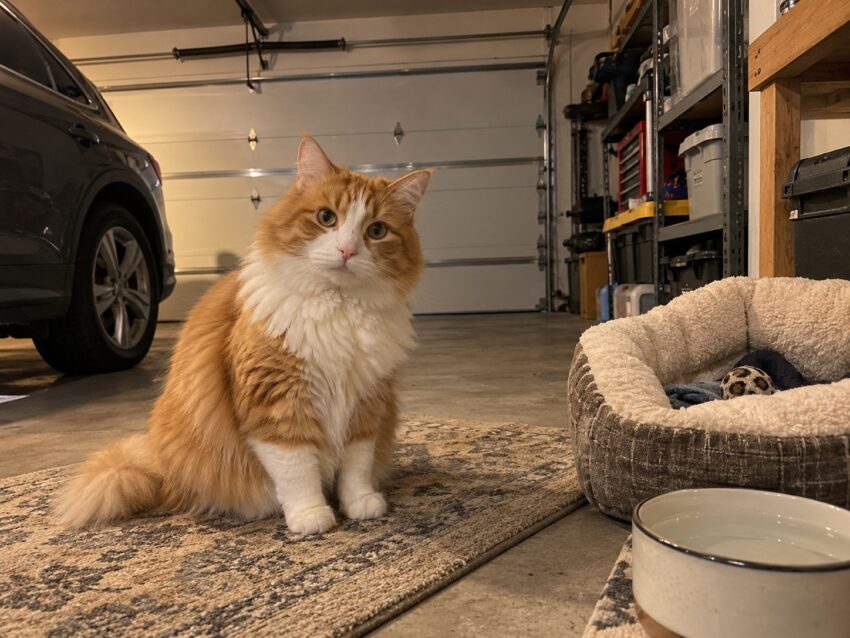
Maybe you need to keep your cat separated from another pet for a few nights. Maybe you’re taking care of a stray that showed up on your porch. Or perhaps your cat simply thinks the garage is the most fascinating room in the house and would very much like you to stop interfering with their plans. Whatever brought you here, the question is the same: Can you keep a cat in a garage at night? The short answer is yes, but only if the garage is actually safe for your cat.
A finished, temperature-controlled garage that’s been thoroughly cat-proofed is one thing. An unheated garage full of antifreeze, power tools, mouse poison and assorted stuff you’ve been meaning to organize since 2017 is quite another.
Let’s look at when a garage can be a safe place for a cat to spend the night, when it isn’t and what you’ll need to do before letting your cat sleep there.
Is It Safe to Keep a Cat in the Garage at Night?
A cat can safely spend the night in a garage if the space is temperature-controlled, well-ventilated, secure and completely free of hazards.
The problem is that the average garage doesn’t automatically meet those requirements.
Garages tend to be where we store everything we don’t particularly want inside the house, including quite a few things we definitely don’t want our cats getting into.
The ASPCA specifically warns about garage hazards such as antifreeze, ice melt, fertilizers and paint. Antifreeze containing ethylene glycol is particularly dangerous because ingesting even a small amount can cause severe kidney damage or death.
So before you consider letting your cat spend the night in the garage, look at the space from their perspective.
And remember, you’re dealing with an animal capable of getting onto a six-foot shelf because they saw something vaguely interesting up there. “Out of the way” isn’t necessarily the same thing as “out of reach.”
7 Things That Can Make a Garage Dangerous for Cats
Even if your garage seems relatively safe at first glance, there are a few hazards worth checking carefully.
1. Extreme temperatures
Most garages aren’t insulated or climate-controlled as well as the rest of the house. That means they can get dangerously cold in winter and surprisingly hot in summer.
Cold weather can put cats at risk for hypothermia and frostbite, particularly when they’re exposed to a combination of low temperatures, wind and moisture. Cornell’s Feline Health Center recommends keeping cats indoors during cold weather whenever possible.
Heat is just as important. Garages can become extremely hot during warm weather, especially when they’re closed up with little airflow. Heatstroke in cats can become life-threatening quickly. Warning signs include excessive panting, drooling, weakness, vomiting, diarrhea or collapse.
We’ll talk more about temperature below.
2. Antifreeze and other automotive fluids
If you only remember one garage hazard from this article, make it this one.
Antifreeze containing ethylene glycol is extremely toxic to cats. It can cause acute kidney failure, and treatment needs to begin quickly after exposure.
Don’t assume that putting the antifreeze bottle on a shelf solves the problem, either. Check the floor for leaks and spills from your vehicle.
Other automotive products can also be dangerous, including windshield washer fluid, brake fluid, gasoline, motor oil and similar chemicals.
If your garage is going to double as a cat room, all automotive chemicals need to be completely inaccessible.
3. Rodent poisons and pesticides
Garages are common places for mouse and rat poisons, insecticides and other pest-control products. Unfortunately, they’re also common places for mice, which means you may have put poison somewhere months ago and completely forgotten about it.
Check carefully before allowing your cat access to the garage. Rodenticides can cause serious poisoning in cats, with effects varying depending on the active ingredient.
Personally, I’d skip rodent poison entirely in any space a cat can access. Your cat has absolutely no respect for the phrase “but I put it where I didn’t think she’d go.”
4. Cars and engines
A parked car presents hazards beyond leaking fluids. Cats are famous for squeezing themselves into warm, enclosed spaces, and vehicles provide plenty of them. Outdoor cats sometimes seek warmth underneath car hoods or around wheels during cold weather.
If a cat has access to a garage where a vehicle is parked, always make sure you know exactly where the cat is before starting or moving the car.
I’d go one step further and avoid moving vehicles in and out of the garage at all while the cat is loose inside.
5. Tools and stored items
Take a good look at your shelves. Sharp tools, nails, fishing supplies, adhesives, paint, batteries, lawn chemicals and heavy objects that could fall aren’t things you want your cat investigating at 2 AM.
Remember that cats don’t limit their exploration to floor level. Secure anything that could fall if a cat jumps onto a shelf, workbench or storage unit.
6. Escape routes
Cats can fit through remarkably small spaces, and garage doors aren’t designed with feline containment in mind. Check around doors, windows, vents and any other openings before assuming the garage is escape-proof.
Pay particular attention to the main garage door. A cat hanging around near it can slip outside astonishingly fast when someone opens it.
If you’re keeping an indoor-only cat in the garage, I’d want a second barrier between the cat and any door that opens directly outdoors whenever possible.
7. Poor ventilation
A garage needs adequate airflow, but ventilation becomes especially important if you store gasoline, paint, solvents or other products that produce fumes.
And obviously, never run a vehicle in a closed garage with your cat inside. Carbon monoxide is dangerous to people and pets alike.
What Temperature Is Safe for a Cat in a Garage?
This is one of those questions where it would be wonderfully convenient to give you one number. Unfortunately, cats haven’t agreed to make things that easy for us.
There isn’t a single garage temperature that’s guaranteed to be safe for every cat.
Age, health, coat, body condition, acclimation and how long the cat will be exposed all matter.
A healthy adult cat with a thick coat may tolerate cooler temperatures better than a very young kitten, senior cat, hairless breed or cat with certain medical conditions.
Very young kittens deserve special attention. Newborn kittens can’t properly regulate their own body temperature and rely heavily on their environment for warmth.
For an indoor pet spending the entire night in a garage, I wouldn’t try to figure out the lowest temperature they can technically tolerate. The better goal is to keep the garage within a comfortable indoor temperature range.
If the garage becomes significantly hotter or colder than your house overnight, that’s a good sign that it isn’t an appropriate sleeping area without climate control.
And don’t rely on how the garage felt when you went to bed. Temperatures can change quite a bit over eight hours. Put a thermometer in the area where your cat will actually sleep and check it.
How to Make a Garage Safe for a Cat Overnight
If you need to use your garage temporarily, treat it like you’re setting up an actual room for your cat rather than simply putting them “out in the garage.”
Start with a thorough cat-proofing session.
Remove or securely lock away chemicals, automotive fluids, pesticides, fertilizers, rodenticides, sharp tools and anything else your cat could ingest, knock over or become tangled in.
Then make sure your cat has:
- A clean, comfortable sleeping area
- Fresh water
- Access to an appropriate litter box
- Food if it fits their normal feeding schedule
- A safe hiding spot
- Comfortable temperatures throughout the night
- Adequate ventilation
- Enough room to move around normally
- A few safe toys or other forms of enrichment
I’d also give the garage a complete inspection at cat level and several feet above it.
Basically, if there’s a shelf, assume your cat can reach it. If you’re positive they can’t reach it, assume they’ll take that personally and find a way.
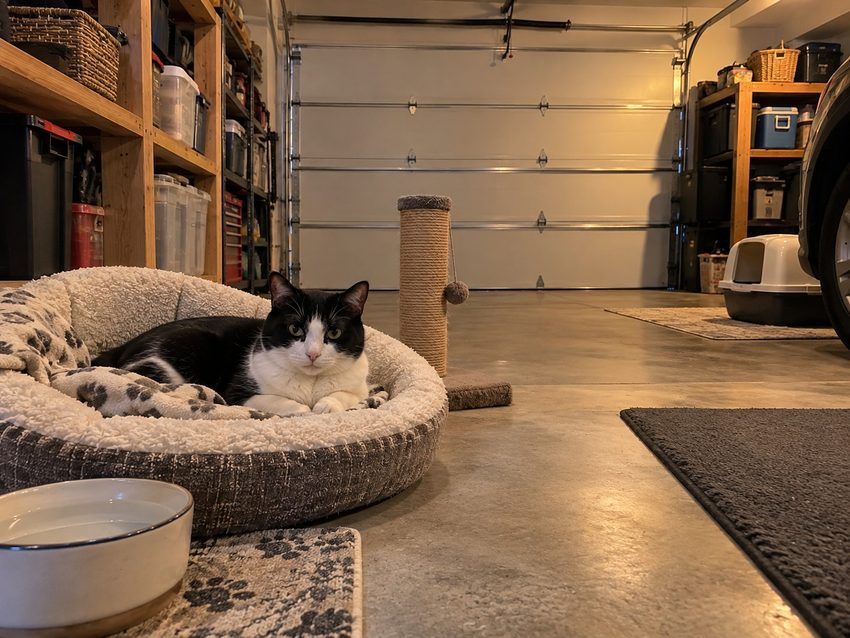
Can a Cat Live in a Garage Permanently?
This is where I’d draw a bigger distinction between sleeping in a safe garage occasionally and living in one full-time.
For a pet cat accustomed to living indoors with people, an ordinary garage isn’t an appropriate permanent replacement for the home.
Even if you’ve eliminated the obvious physical hazards, cats need more than food, water and somewhere to sleep. They need interaction, enrichment, places to climb and hide, opportunities to play and enough comfortable living space to behave normally.
Now, if you’ve genuinely converted the garage into living space with heating and cooling, secure windows, appropriate flooring, furniture, climbing areas and all the other things your cat needs, that’s different.
At that point, though, we’re basically talking about a cat room that happens to have a very large door on one wall.
What About Letting a Stray or Community Cat Sleep in the Garage?
This is a different situation entirely. If an outdoor cat is hanging around your property during freezing temperatures or severe weather, providing access to a safe garage may give them additional shelter from the elements.
Alley Cat Allies even notes that some caregivers allow community cats access to garages, provided the space has first been cleared of harmful chemicals and other hazards.
However, don’t accidentally trap a community cat inside overnight unless there’s a specific reason to confine them.
A cat accustomed to living outdoors may become extremely stressed if suddenly locked inside an unfamiliar building.
If you simply want to provide protection from the weather, a properly designed outdoor cat shelter may be a better option. Good outdoor shelters should be waterproof, windproof and elevated from the ground. Straw is recommended for insulation because it resists moisture, while blankets and towels can absorb water and become cold.
If a friendly stray appears to be lost or abandoned, that’s another matter. Have the cat scanned for a microchip and check with neighbors and local lost-pet groups before assuming you’ve acquired a new garage tenant.
If you DO decide to welcome strays or ferals into your garage, consider adding a pet door for them so they can come and go. While you could go all out and install one directly in your garage door or even cut into the wall, a window insert works just as well as long as your garage window is fairly close to the ground.
Give your cat the freedom to come and go without cutting into walls or doors! This easy-install cat door fits sash windows 24"–28" wide and sets up in just 10 minutes—no tools required. Featuring a magnetic closure to keep out wind, rain, and pests, plus weatherstripping for a snug, energy-efficient seal. The four-way locking system lets you control access (in, out, both, or locked), while the durable aluminum frame and hard plastic flap ensure long-lasting use. Includes foam and vinyl draft seals, plus a 3-year warranty for peace of mind.

What Are Better Alternatives to Keeping a Cat in the Garage?
Sometimes the garage isn’t really the issue. You simply need a separate place for your cat overnight.
Maybe you’re introducing two cats, bringing home a new kitten, separating pets who aren’t getting along yet or keeping a particularly determined feline away from something happening elsewhere in the house.
If that’s the case, a bathroom, spare bedroom, office or another closed-off indoor space is usually easier to make comfortable and safe.
Even a relatively small room can work temporarily as long as your cat has room for their litter box, water, sleeping area and other necessities.
The important part is figuring out why you need to separate your cat in the first place. Once you know that, you may find there’s an easier solution than turning the garage into Kitty Studio Apartment #1.
Can You Keep a Kitten in the Garage Overnight?
I wouldn’t recommend keeping a young kitten in a typical garage overnight.
Kittens are exceptionally curious, small enough to squeeze into spaces you’d never expect and more vulnerable to temperature extremes than healthy adult cats. Very young kittens can’t adequately regulate their body temperature at all.
If you need to separate a kitten overnight, an indoor bathroom, bedroom or properly set-up kitten enclosure is a much safer choice.
Can You Put a Litter Box in the Garage?
Sure, assuming your cat can safely access the garage. In fact, some people permanently keep litter boxes there to get them out of the main living areas.
Just don’t forget that “out of sight, out of mind” applies remarkably well to litter boxes. Scoop it regularly and make sure your cat can reach it whenever they need it.
Also think carefully before making the garage your cat’s only litter box location. If the garage becomes too hot, cold or temporarily inaccessible because someone closes a door, your cat suddenly has nowhere appropriate to go.
What Type of Litter Box Is Best for a Garage?
The best litter box for a garage depends quite a bit on what kind of garage we’re talking about.
If your garage is finished, climate-controlled and basically functions like another room in your house, an automatic litter box can work perfectly well. This can be especially convenient if the garage is where you permanently keep one of your cat’s litter boxes, since you won’t have to remember to trek out there and scoop it several times a day.
Just make sure the garage has reliable power and Wi-Fi if your particular model requires them. You’ll also want to check the manufacturer’s operating temperature recommendations. Electronics, motors and sensors aren’t necessarily designed to work reliably in a garage that gets extremely hot, cold or humid.
Meet the next generation of smart litter boxes. The Litter-Robot 5 features a sleek LCD display, redesigned waste drawer for fewer empties, customizable lights, and better odor control than ever. Multi-cat ready and app-connected, it’s the perfect balance of convenience, performance, and modern design for any cat household.
⭐ BEST PRICE ON THE WEB⭐
SAVE UP TO $150!

For an unfinished or non-climate-controlled garage, I’d stick with a traditional litter box. There are fewer things to malfunction, and you don’t have to worry about electronics being exposed to temperature swings or moisture.
A stainless steel litter box is particularly nice for a garage setup. Unlike plastic, stainless steel doesn’t absorb odors, and it’s resistant to the scratches that eventually make plastic boxes harder to thoroughly clean. It’s also easy to wash and sanitize.
That doesn’t mean you need to buy a stainless-steel box just for the garage, though. A sturdy plastic litter box is perfectly fine if that’s what you already have. Just inspect it periodically for deep scratches, cracks and lingering odors.
Made from stainless steel with a large 23-inch frame, go time won’t be a problem as this box not only offers plenty of room, but it’s less likely to crack. This sleek design features an easy-to-clean surface that won’t pick up odors that are left behind.

Whichever type you choose, don’t let the garage location turn the litter box into an “out of sight, out of mind” situation. Automatic boxes still need their waste bins emptied and components cleaned, and traditional boxes still need regular scooping. Your cat will absolutely notice if you forget about it, even if you don’t.
Can You Leave a Cat in the Garage While You’re at Work?
The same basic rules apply whether you’re leaving your cat in the garage overnight or during the day. If it’s a genuinely cat-safe, climate-controlled space with everything your cat needs, several hours there may be fine for a healthy adult cat.
If it’s an ordinary garage that gets hot when the sun hits it, contains chemicals or has other hazards, leaving your cat unattended there isn’t a good idea.
In fact, daytime temperatures can make a garage even more concerning during warmer months.
Final Thoughts
So, can you keep a cat in a garage at night? Yes, but only if you’ve made the garage as safe and comfortable as any other room you’d leave your cat in unattended.
That means appropriate temperatures, fresh water, a litter box, somewhere comfortable to sleep, good ventilation and absolutely no access to antifreeze, automotive chemicals, rodent poison, dangerous tools or other hazards.
For an occasional overnight stay, a properly prepared garage can work.
For long-term living, an ordinary garage isn’t a great substitute for indoor living space. And if your garage isn’t climate-controlled or thoroughly cat-proofed, you’re better off finding your cat a safe room inside the house.
Cats are remarkably good at finding hazards we didn’t know existed. There’s really no reason to give them an entire garage full of new ones to discover.